A sense of discontent in where we live is, for Americans, an all-too-common occurrence.
It is, at least partly, an artifact of where we are as a relatively young nation still figuring out what it wants to be — and where.
Determining where to go for a better quality of life is one of the most consequential decisions a person can make, and even with the entirety of the internet at our disposal, it remains genuinely difficult research to do well.
I had the idea for this series on a sunny afternoon, sitting outside with a cold cider and Spanish guitar music, enjoying the kind of ease that a good day in a good place produces – and wanting to translate that into an everyday, everywhere experience.
Finding Ease
That word — ease — is at the center of everything Principles of Place is about.
The core argument is simple: the design of a place, its streets, its transit, its zoning, its public spaces, determines how much friction daily life imposes on the people who live there.
Ease of movement, ease of access, ease of simply existing without a car as a prerequisite for every errand — these aren’t amenities. They are the upstream conditions that produce downstream goods: security, belonging, financial stability, proximity to the things that make life worth living.
But ease is not only about infrastructure.
A city can have excellent sidewalks, protected bike lanes, and a functioning bus network and still feel like there is nowhere worth going. Ease is also about what exists along those thoroughfares — the mix of restaurants, coffee shops, independent businesses, and yes, the national retailers and services that people actually use in daily life.
A walkable street with nothing on it is not a walkable street in any meaningful sense. The infrastructure creates the possibility, and the amenities create the reason.
Getting both right requires not just good planning but zoning that allows density and mixed use, economic conditions that attract investment, and the kind of civic culture that supports local businesses while also making room for the anchors that give people practical reasons to leave the car at home.
Cities that understand this — that ease is the combination of how you move through a place and what you find when you get there — are the ones this series is about.
The visibility problem
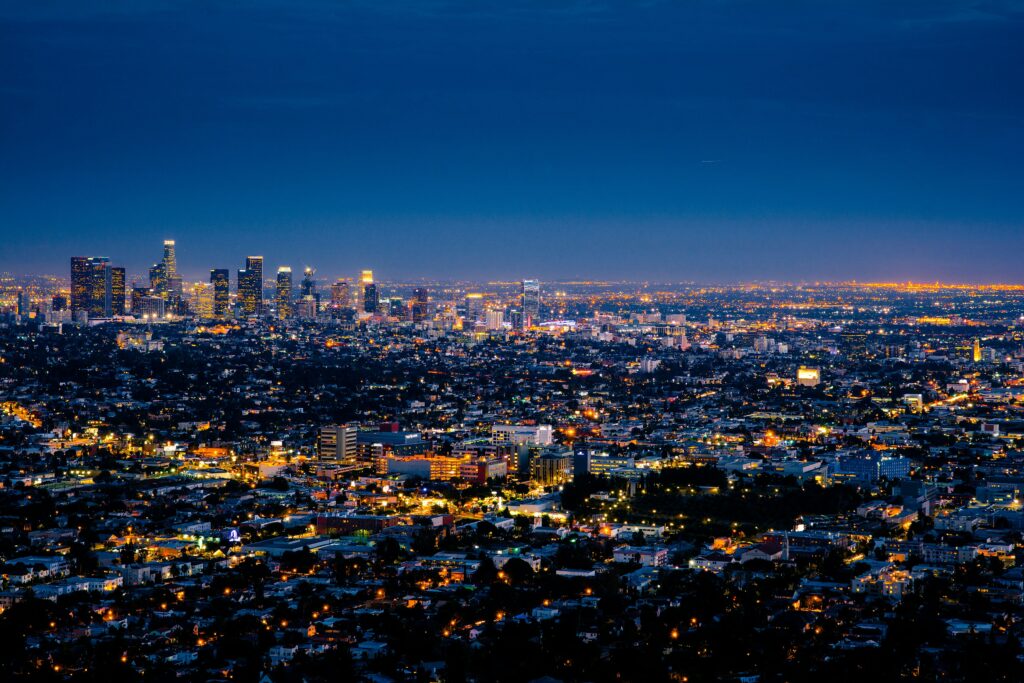
When most people think about great American cities, the same names surface immediately. New York. Los Angeles. Chicago.
From there, a second tier: San Francisco, Seattle, Miami, Denver, Boston, and countless others. These cities occupy an outsized share of the national imagination — and for good reason. They offer genuine density, culture, opportunity, and urban infrastructure at a scale that smaller places simply cannot match.
If those are the things you want, and you can navigate the tradeoffs that come with them — the cost, the competition, the sheer scale — they remain among the best places in the world to live.
But they are not the only good places. And for most Americans, particularly those in their twenties, thirties, and forties, they may not even be the right places – something we’ll get into later.
Below those well-known tiers, there is a layer of American cities that most people simply cannot evaluate.
Not because the cities are bad, but because nobody has made a compelling case for them. They lack the cultural footprint, the media presence, and the established narrative that makes a city legible to someone researching from the outside.
What’s important to note is that the information gap is not a reflection of quality. It is a reflection of visibility.
That is the gap this series exists to fill.
What fastest-growing actually means
There is a tempting shortcut when researching cities: look at which ones are growing fastest. Population growth is easy to find, widely reported, and feels like a reliable proxy for quality of life.
If people are moving there, it must be because things are good. It must be an indicator of ease, in some way or another.
It is not.
The fastest-growing cities in America over the past decade have largely been in Texas, Florida, and Arizona. The growth is real, and some of it reflects genuine opportunity — lower costs, available land, job markets that absorbed migration.
But growth and livability are different things, and conflating them has led a lot of people into decisions they are now reconsidering.
The clearest example is what has happened to property insurance in parts of Florida. Cities that were, not long ago, among the most attractive and accessible have seen insurance markets collapse under the combined weight of hurricane exposure, flood risk, and the financial mathematics of climate change.
In some coastal communities, these changes have created a reality where homeowners cannot sell their properties at any price. The cost of living was cheap — right up until it wasn’t. What looked like opportunity was actually deferred cost, and the deferral is ending.
This is not an isolated story. It is a preview of what happens when the design decisions and climate realities of a place finally catch up to its reputation.
A city of the future, as this series defines it, is not the city that is hot and ultra-well-known right now. It is the city, however, that is already making the right moves; the one that will still likely be viable, insurable, affordable, and livable in ten, fifteen, and twenty years — when some of the currently celebrated cities may be struggling in ways that are already visible to anyone paying attention.

The freshwater question
One of the most underappreciated factors in long-term urban viability is something that almost never appears on a quality-of-life ranking: access to fresh water.
For decades this has been a background concern — drought cycles, occasional shortages, periodic warnings that never quite materialized into lasting crisis. That era is ending, and saying so is not sensationalism. Ask any farmer or rancher in the Southwest.
What is happening now across the interior West is not a transient drought with a recovery on the other side. It is a structural decline.
What makes things worse is that many deny it is even an issue, and are doing nothing to try and solve it before it reaches a tipping point.
There are tens of millions of people who will, in coming years, be reckoning with the dilemma of not just of where to go, but what to do with what they have and how to derive whatever remaining value there is in what they have to support a relocation elsewhere.
On the flip side of things, we have the Great Lakes, which holds approximately 21 percent of the world’s surface freshwater. Not just North America. The entire world.
The cities in their orbit sit atop a resource that is going to matter enormously in the coming decades — not as a selling point in a real estate brochure, but as a basic precondition for a viable future.
This is not alarmism. It is arithmetic.
The wealth-building argument
There is another reason to look seriously at the cities in this series, one that is more personal and more immediate than climate or infrastructure.
For too many Americans — particularly those in their thirties and forties — the path to ownership, equity, and financial stability has been replaced by an open-ended arrangement with a landlord and a rental market that takes everything and builds nothing. Not by choice, in most cases. By apparent necessity. The expensive, well-known cities have become places where you pay a corporation’s mortgage instead of your own, where five years of rent receipts produce no equity, no stake, no future — just the continued privilege of proximity to what looks like opportunity.
The cruelest part is that many of those people would leave if they knew where to go. They stay not because these cities are irreplaceable, but because the alternatives are invisible. Nobody has made a compelling case for them.
This series is, in part, that case. The cities here are places where you can still buy in at a price that makes financial sense. Where appreciation is real and accessible, not theoretical. Where being early — moving before a place becomes obvious — is still possible, and where the people who do it stand to build something lasting for themselves and for the communities they join.
How we evaluate cities — and what we can and can’t measure
Principles of Place is built around a framework for evaluating quality of life through the lens of ease. For this series, that framework translates into a set of questions we ask about every city we consider: How walkable is it, really? How bikeable? Does it have functioning public transit, or the meaningful beginnings of one? Has it reformed its zoning in ways that favor mixed use and density? Is there political will at the city and state level to keep improving, or is the current state the ceiling? How does its affordability compare to what it offers? And what does the climate trajectory look like over the next twenty years?
We look at available data — Walk Score, Bike Score, Transit Score, cost of living indices, home price to income ratios, tax burden. Where it exists and is reliable, we use it. But the further down the population ladder you go, the thinner and less consistent that data becomes. For a city of two million, there are rankings, indices, and analyses from dozens of sources. For a city of two hundred thousand doing genuinely interesting work, you may find a few local news articles, a mention in an urbanist publication, and a Walk Score that doesn’t quite capture what the downtown actually feels like on a Wednesday afternoon.
At the scale of cities we are examining, qualitative judgment is not a compromise. It is the appropriate tool. What we offer is not a formula. It is a framework applied with editorial honesty — our best assessment of what each city is, what it is becoming, and why we think it belongs on a list of places worth paying attention to.
The criteria are the lens. The conclusion is ours to own, and yours to argue with.
The Cities
The cities below are organized into two sets by metropolitan statistical area population. These ranges — 500,000 to 1 million and 150,000 to 500,000 — were targets, not hard filters. A few entries exceed or fall short of their set’s stated ceiling; in each case the editorial judgment was that the city’s character and trajectory mattered more than where the census draws the line. All population figures refer to MSA, not city proper.
The 500K-1M Set
Cincinnati, Ohio (MSA ~2.3M) is the anchor pick — a city with a complete urban amenity stack, a zoning reform passed and in effect, and a transit system operating at 117 percent of pre-COVID ridership while the national average sits at 70 to 80. Bus Rapid Transit on two corridors launches in 2027 and 2028. The entry price has not yet caught up to what the infrastructure investment is building toward.
Madison, Wisconsin (MSA ~680,000) launched its first Bus Rapid Transit line in September 2024, has a second federally funded line on track for 2028, and carries the strongest safety profile of any city in either set. The university gives it cultural and intellectual depth well above its population size. Passenger rail to Chicago is in active planning with a realistic 2030 to 2032 timeline. Prices are higher than the Midwest average but still rational relative to what the city offers.
The Upstate New York Corridor: Albany and Syracuse (MSAs ~900,000 and ~650,000) are treated as a paired entry because the argument for both depends on understanding what is happening between them. Albany anchors the R&D end of the national semiconductor corridor, home to the country’s first National Semiconductor Technology Center and over 10,000 people already employed in chip research and manufacturing. Syracuse sits 60 miles west, 14 miles from Micron’s $100 billion megafab that broke ground in January 2026, and in the middle of the most significant urban infrastructure project happening in any American city its size — the demolition of the I-81 viaduct and its replacement with a community street grid. Both cities have direct Amtrak service to Penn Station. Neither has housing prices that reflect what is coming.
The 150K-500K Set
Grand Rapids, Michigan (MSA ~1.07M) passed a unanimous zoning reform in April 2024 eliminating parking minimums for small multifamily development and simplifying ADU approvals — a decisive policy move backed by an active Strong Towns chapter and a new Master Plan oriented around transit corridors. Clean, growing, and affordable at a median home price around $230,000, with Great Lakes climate resilience and Amtrak access to Chicago.
Rochester, Minnesota (MSA ~230,000) is ten years into a $5.6 billion public-private downtown transformation anchored by Mayo Clinic, received an $84.92 million federal BRT grant in 2024, and was the first Minnesota metro to recover from COVID job losses. One of the safest and most institutionally deep small cities in the country. The single-employer dependency on Mayo is the variable to watch.
Roanoke, Virginia (MSA ~315,000) is the only Southern entry on this list and the most physically distinctive — a valley city framed by the Blue Ridge with a functioning historic downtown, over 14 miles of completed greenway, and a City Market that has operated continuously since 1882. Median home prices around $225,000 to $293,000, with some of Virginia’s highest year-over-year appreciation in 2025 as buyers priced out of Northern Virginia and Richmond discover what Roanoke actually is.
Champaign-Urbana, Illinois (MSA ~240,000) has the University of Illinois at Urbana-Champaign as its anchor — one of the top five public engineering and computer science universities in the world — and Amtrak service to Chicago in 2.5 hours. The most rational pure value play on this list: a city whose quality of life consistently outperforms its price, with an institutional foundation that isn’t going anywhere.
Dayton, Ohio (MSA ~800,000) closes this set rather than leads it for reasons of geographic distribution rather than merit. At a median home price of $130,000 and average one-bedroom rent of $849, it carries the most compelling affordability numbers on either list. AdaptDayton, a comprehensive zoning reform explicitly modeled on Cincinnati’s Connected Communities, is actively underway. Wright-Patterson Air Force Base provides an essentially recession-proof employment floor. The entry point is the argument.
Conclusion
Every city on this list will be wrong for someone. A few will surprise people who move to them — in both directions. What they share is a combination of physical form, policy direction, and economic positioning that makes them more likely than not to be better places to live in 2035 than they are today, at prices that still reflect yesterday’s assessment of what they are worth. The window that creates is not unlimited, and it is not identical across all eight entries. But it is real, and it is open now, and that is what this series has been trying to say.